How Bicycle and E-Bike Bills Become Law in California: Understanding the Legislative Process
How Does an Idea Become California Law?
California's bicycle laws have evolved for decades, but the rapid growth of e-bikes and high-powered electric vehicles has accelerated the pace of proposed legislation. Lawmakers continue to consider new rules aimed at protecting cyclists and improving safety for everyone who uses California roads.
But how does an idea for a new bicycle or e-bike law actually become California law? Who can propose a change, how does that idea reach a legislator, and when you hear that a bill has "passed," does that mean it is already law?
This guide explains how bicycle and e-bike laws are made in California, from the initial idea to the Governor's desk, and why some bills become law while others are amended, rejected, vetoed, or returned in another legislative session.
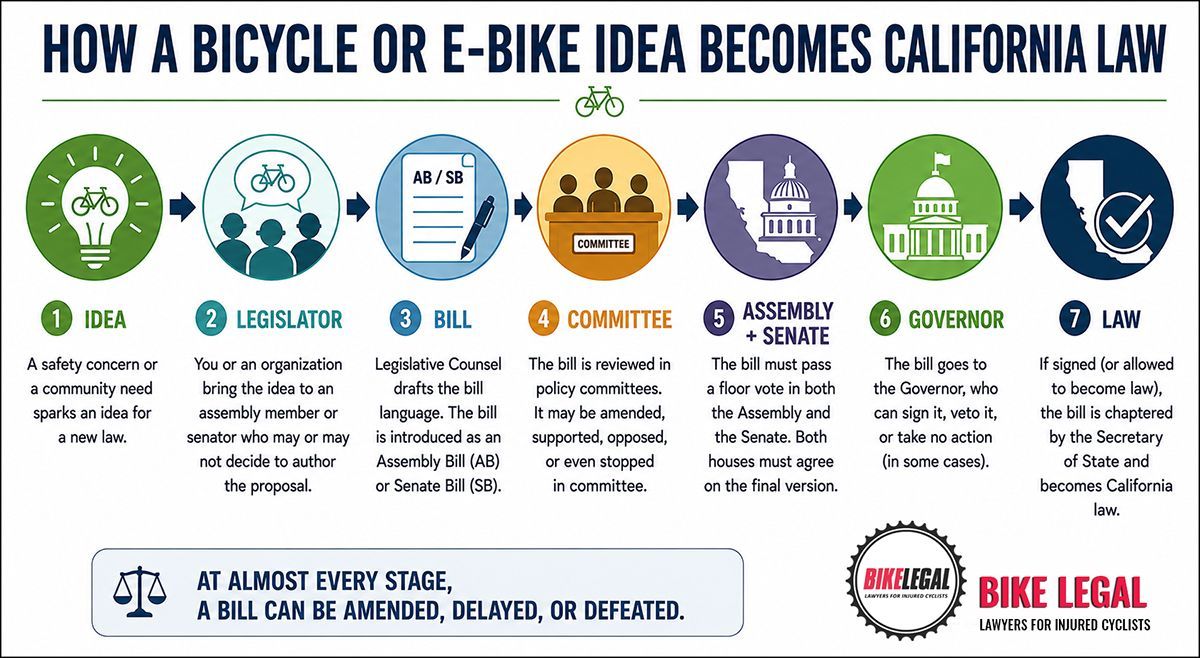
Step 1: It Starts With an Idea
An idea for a new California bicycle law can come from anyone, including residents, advocacy organizations, local governments, law enforcement, state agencies, researchers, and industry groups.
Ideas often emerge in response to safety concerns, community complaints, increases in crashes and injuries, enforcement problems, or gaps in existing law. E-bikes are a good example of how quickly new issues can arise. Their rapid growth, along with high-powered electric vehicles being marketed as e-bikes, has raised regulatory and safety questions that many existing bicycle laws were not written to address.
The important distinction is that anyone can propose an idea for a new law, but only a California legislator can introduce a bill.
Step 2: Bring the Idea to a California Legislator
If you believe California law should change, you can bring your idea to a member of the California Assembly or Senate. A good place to start is with the legislators who represent your district.
Individuals and organizations can contact legislative offices, meet with lawmakers or their staff, explain the problem, and provide research, crash data, personal experiences, or other information supporting the proposed change. You can also work with an advocacy organization, such as CalBike, that already works with legislators on bicycle policy.
If a legislator believes the issue warrants legislative action, they may agree to author and introduce a bill. An outside organization that helps develop or advocate for the proposal may serve as a sponsor, while other legislators may join as coauthors.
How does an idea actually start its journey through the California Legislature? This video provides a quick look at how a bill idea begins its journey through the legislative process.
Step 3: The Idea Becomes an Assembly or Senate Bill
Once a legislator agrees to pursue an idea, the Office of Legislative Counsel helps draft it into formal legislative language.
A bill introduced by an Assemblymember becomes an Assembly Bill (AB), while one introduced by a Senator becomes a Senate Bill (SB). The bill is assigned a number, printed, and formally introduced. Generally, it must be in print for 30 days before it can be acted upon.
The original bill is only a starting point. Bills can be amended several times as they move through the Legislature, so the version ultimately voted on may look very different from the one first introduced.
Step 4: Committees Review and Amend the Bill
After introduction, the bill is assigned to the appropriate policy committee, or sometimes more than one.
Bicycle and e-bike bills are often heard by the Assembly or Senate Transportation Committee.
Committees review the proposal, hear support and opposition, consider amendments, and vote on whether the bill should move forward. Bills that impose high costs on the state may also be reviewed by the Appropriations Committee.
A bill can be approved, amended, held, or defeated during committee review. This is one of several points at which a proposed law can die before ever reaching a vote in the full Assembly or Senate.
Step 5: The Assembly and Senate Vote
A bill must first pass the chamber where it was introduced:
AB → Assembly → Senate
SB → Senate → Assembly
After passing its first chamber, the bill moves to the other, where it goes through committee review and a floor vote again. Most bills require a simple majority: 41 of 80 Assembly members or 21 of 40 Senators.
If the second chamber amends the bill, the originating chamber must agree to those changes before it can move forward.
Passing a committee is not the same as passing the Legislature. A bill must pass both the Assembly and Senate before it can be sent to the Governor.
Step 6: The Bill Goes to the Governor
Once the Assembly and Senate approve the same version of a bill, it is enrolled and sent to the Governor.
The Governor can:
- Sign it: The bill becomes law.
- Veto it: The bill does not become law unless the Legislature overrides the veto with a two-thirds vote in both houses.
- Take no action: The bill can become law without the Governor's signature.
The Governor generally has 12 days to act, although different deadlines apply near the end of the legislative year.
Step 7: The Bill Becomes Law
If the Governor signs the bill, or allows it to become law without a signature, it is sent to the California Secretary of State, where it is chaptered as a new law.
But becoming law and taking effect are not necessarily the same thing. Most regular-session statutes take effect January 1 of the following year, although there are exceptions.
Not Every Bicycle or E-Bike Bill Becomes Law
A bill can stall or fail at almost any point in the legislative process. It may be held in committee, fail a floor vote, stall in Appropriations, or make it through both houses only to be vetoed by the Governor.
California bicycle and e-bike legislation provides examples of several different outcomes:
SB 1271 and AB 1774 became law. Both bills completed the legislative process and were signed by the Governor, creating new requirements affecting e-bikes in California.
AB 1942 stalled in Appropriations. Introduced in 2026, AB 1942 would require Class 2 and Class 3 e-bikes to be registered with the DMV and display special license plates. The bill passed the Assembly Transportation Committee 12-0 but was referred to the Assembly Appropriations Suspense File and held under submission on May 14, 2026. As of August 2026, it has not advanced to an Assembly floor vote.
AB 122 passed the Legislature but was vetoed. The 2021 “bicycle safety stop” bill would have allowed cyclists to treat stop signs as yields under certain conditions. It passed both houses before being vetoed by Governor Gavin Newsom.
A bill that stalls, fails, or is vetoed is not necessarily gone for good. Lawmakers can revise the proposal and introduce it again in a future legislative session.
California’s Repeated Attempts to Pass an “Idaho Stop” Law
California’s bicycle safety stop provides a good example. Commonly called an “Idaho stop,” the proposal would allow bicyclists to treat stop signs as yield signs under certain conditions.
After Governor Newsom vetoed AB 122 in 2021, citing safety concerns, particularly for children, lawmakers tried again. AB 1713 in 2022 limited the proposal to riders 18 and older but was placed on the Senate inactive file. AB 73 in 2023 proposed another version for adults, but its Senate Transportation Committee hearing was canceled at the author’s request, and the bill did not advance.
The repeated attempts show how lawmakers can modify and reintroduce an idea in response to concerns that prevented an earlier bill from becoming law.
When Does a Bill Actually Become California Law?
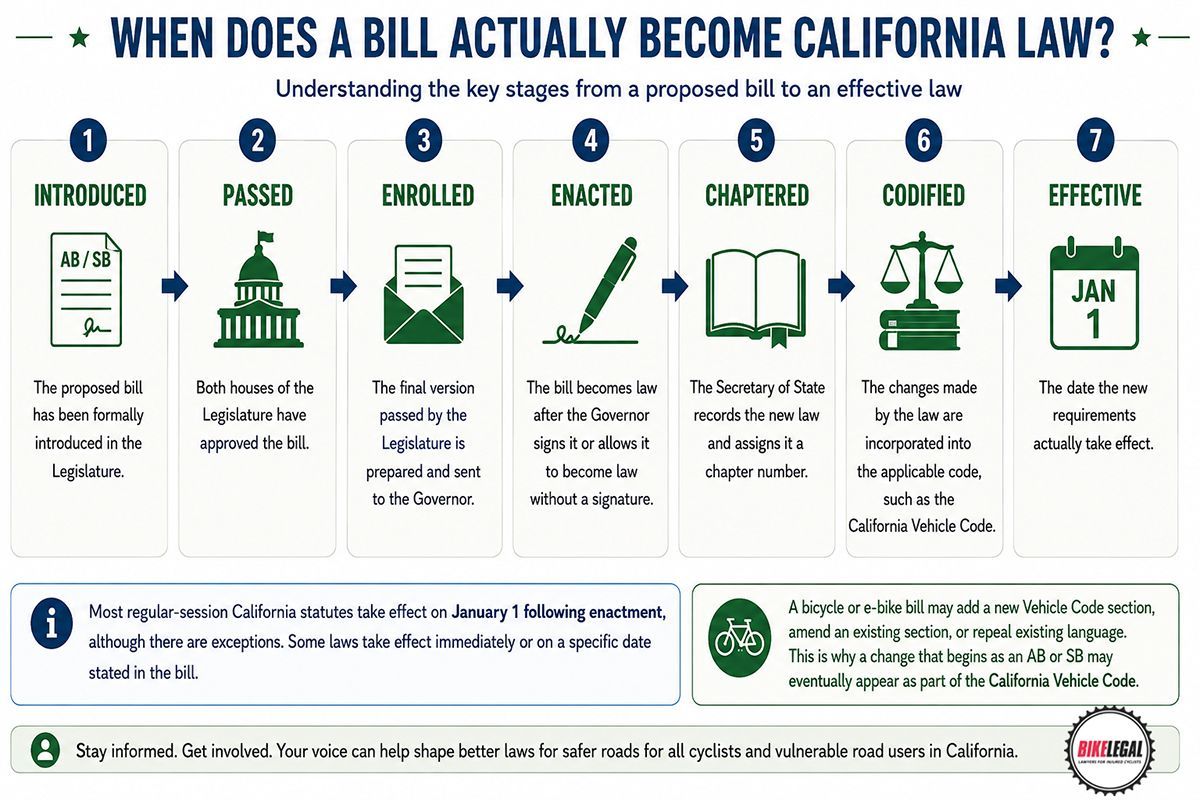
When following California legislation, terms such as passed, enacted, chaptered, codified, and effective can be confusing because they describe different stages of the process.
- Introduced: The proposed bill has been formally introduced in the Legislature.
- Passed: Both houses of the Legislature have approved the bill.
- Enrolled: The final version passed by the Legislature is prepared and sent to the Governor.
- Enacted: The bill becomes law after the Governor signs it or allows it to become law without a signature.
- Chaptered: The Secretary of State records the new law and assigns it a chapter number.
- Codified: The changes made by the law are incorporated into the applicable California code, such as the Vehicle Code
- Effective: The date the new requirements actually take effect.
Most regular-session California statutes take effect on January 1 following enactment, although there are exceptions.
A bicycle or e-bike bill may add a new California Vehicle Code section, amend an existing section, or repeal existing language. This is why a change that begins as an AB or SB may eventually be codified in the Vehicle Code.
How Can You Follow or Get Involved With a California Bicycle or E-Bike Bill?
Once a bill has been introduced, you can follow its progress through California Legislative Information (LegInfo). Search by the AB or SB number to see the current bill text, amendments, committee analyses, votes, legislative history, current status, and any action by the Governor.
The public can also participate as a bill moves through the Legislature. You can contact your Assemblymember or Senator, submit support or opposition to a committee, provide public comment, work with advocacy organizations such as CalBike, or contact the Governor about a bill that reaches their desk.
Because bills can change significantly as they move through the process, always check the current bill language and status before assuming a proposed bicycle or e-bike rule is already California law.
Why Understanding the California Legislative Process Matters for Cyclists
California bicycle and e-bike laws don't change simply because someone proposes a new rule. Some proposals become law, others are substantially amended or fail, and some return in future legislative sessions. Understanding the process helps cyclists distinguish between proposed legislation and the laws that actually apply on California roads today.
More importantly, all bicyclists have a voice in the laws that affect their safety and protect their rights. If you see a problem or have an idea that could make California safer for cyclists, speak up. Contact your legislators, connect with others who share your concerns, work with bicycle advocacy organizations, and build support for change. Many new laws begin with people in the community who recognize a problem and are willing to get involved.
Injured in a Bicycle or E-Bike Crash? Bike Legal Can Help
At Bike Legal, we don't just represent injured cyclists. Our legal team consists of cyclists and advocates who closely follow and support legislation that improves safety and protects the rights of bicyclists and other vulnerable road users.
If you are injured in a bicycle crash, an experienced California bicycle accident lawyer can protect your rights, handle the insurance and legal process, and fight for the maximum compensation available for your injuries and damages.
We also encourage California's cycling community to stay informed, get involved, and speak up for laws that make our roads safer.
If you or someone you know has been injured in a bicycle or e-bike crash, contact Bike Legal today.
📞 Call 877-BIKE-LEGAL (877-245-3534) for a free consultation. No obligation, no upfront costs.
Frequently Asked Questions About California Bicycle and E-Bike Legislation
How does a bill become law in California?
A bill must be introduced by a California Assemblymember or Senator, reviewed by legislative committees, and approved by both the Assembly and Senate. It is then sent to the Governor, who can sign it, veto it, or allow it to become law without a signature. Once enacted, the law is chaptered by the Secretary of State and takes effect on its designated effective date.
Can anyone propose a new bicycle or e-bike law in California?
Yes. Anyone can propose a new California bicycle or e-bike law, including individual residents, cyclists, advocacy organizations, local governments, businesses, and community groups. However, only a member of the California Legislature can formally introduce a bill. If you have an idea, you can contact your Assemblymember or state Senator and ask them to consider the proposal.
Does a California bill become law as soon as it passes the Assembly and Senate?
No. Passing both the California Assembly and Senate does not automatically make a bill law. The bill must still be sent to the Governor, who can sign it, veto it, or allow it to become law without a signature. A new law also has an effective date that determines when its requirements actually take effect.
When do new California bicycle and e-bike laws take effect?
Most California laws enacted during a regular legislative session take effect on January 1 following enactment. However, there are exceptions, including urgency statutes and laws that specify a different effective date. Cyclists should always check the effective date before assuming a newly enacted bicycle or e-bike law is already in effect.
How can I find out if a California bicycle or e-bike bill has passed?
Use the official California Legislative Information website, LegInfo, and search for the AB or SB number. The bill page shows its current status, text, amendments, committee analyses, legislative history, votes, and Governor actions. Always check both the current status and the latest bill language, as a pending bill may change substantially during the legislative process.
How can cyclists support or oppose a proposed California bicycle law?
California cyclists can contact their Assemblymember or state Senator, submit letters of support or opposition, participate in committee hearings and public comment, work with bicycle advocacy organizations, and encourage other community members to get involved. If a bill reaches the Governor, cyclists can also contact the Governor's office to request that the bill be signed or vetoed.
Bike Legal Spoke & Law Blog


Ride Protected
Ride Safe, with Bike Legal
At Bike Legal, our mission is to advocate for bicycle safety and to share the road responsibly through education. Our legal team is committed to supporting and representing cyclists across the United States, no matter where you ride or how you ride.