California’s Landmark Electric Bicycle Safety Study Reveals Why Regulating E-Bikes Is So Complicated
Why Is E-Bike Regulation Such a Mess?
In 2023, California lawmakers commissioned one of the most comprehensive electric bicycle safety studies ever conducted in the United States. The 210-page report from the Mineta Transportation Institute (MTI) at San Jose State University examined electric bicycle crashes, injuries, fatalities, infrastructure, rider behavior, and regulations.
Although the study was conducted for California through Senate Bill 381 (2023), it provides a broad look at the growing national challenges surrounding how electric bicycles are defined, classified, tracked, and regulated.
One of the report’s most important conclusions is that many of the devices involved in reported e-bike incidents are not legally qualified as electric bicycles at all.
Researchers repeatedly identified major gaps in how electric bicycle crashes and injuries are classified and reported, raising questions about the reliability of the data currently shaping the e-bike regulation debate.
As the report explains,
There is a disconnect between devices the public assumes are electric bicycles and those defined as such by law.
The study was conducted by researchers at the Mineta Transportation Institute (MTI) at San Jose State University, one of the nation’s leading transportation research organizations.
Why California Ordered a Statewide E-Bike Safety Study
The Mineta Transportation Institute (MTI) Electric Bicycle Safety Study was commissioned through California Senate Bill 381 (2023), which directed researchers to help policymakers develop effective laws and policies that simultaneously advance two goals: expanding electric bicycle use and protecting the safety of both riders and other road users.
To accomplish this, researchers examined three major areas:
- Electric Bicycle Laws and Regulations
The report reviewed how California, other U.S. states, and countries worldwide currently define and regulate electric bicycles.
- Crash, Injury, and Fatality Data
Researchers analyzed available electric bicycle safety data, including crashes, injuries, emergency room visits, and fatalities.
- Potential Safety and Policy Solutions
The study explored strategies California could adopt to promote safer electric bicycle use, including changes to infrastructure, education, enforcement, public awareness, and the California Vehicle Code itself.
The report emphasizes that electric bicycles offer significant transportation benefits. More than half of all trips in the United States are under three miles, making e-bikes a practical alternative to driving for many Californians, including older adults, children, and people who cannot or prefer not to drive.
At the same time, concern surrounding electric bike safety has increased rapidly as reports of crashes, injuries, and fatalities involving e-bikes continue to rise.
Researchers state that the goal of the study is not to discourage e-bike use, but rather to help policymakers better understand both the known safety risks and the major data gaps that currently shape the regulatory debate.
E-Bikes and “Bicycle-Shaped Electric Devices” Have Exploded in Popularity
Electric bicycles and other bicycle-shaped electric devices have grown rapidly in popularity across the United States. Researchers estimate there are now approximately 7 million of these devices nationwide, roughly 49 times as many as in 2020.
Sales data reflects similar growth. One industry estimate found that U.S. e-bike sales increased from roughly 250,000 units in 2019 to more than 1 million in 2022.
Market research firm Circana reported growth from approximately 50,000 units in 2017 to more than 527,000 units in 2022. In California alone, more than $529 million worth of electric bicycles were sold in 2024.
The report also notes that more than 10% of U.S. adults now say they ride electric bikes. Researchers emphasized that rising crash and injury numbers must be viewed in the context of rapidly increasing ridership and device ownership.
But the study found that growth itself is not the only challenge. Regulators are increasingly struggling to define what many of these devices actually are.
Researchers noted that the fastest-growing segment of the market appears to involve higher-powered electric devices that may not legally qualify as electric bicycles under California law.
Defining an Electric Bicycle Is More Complicated Than Most People Realize
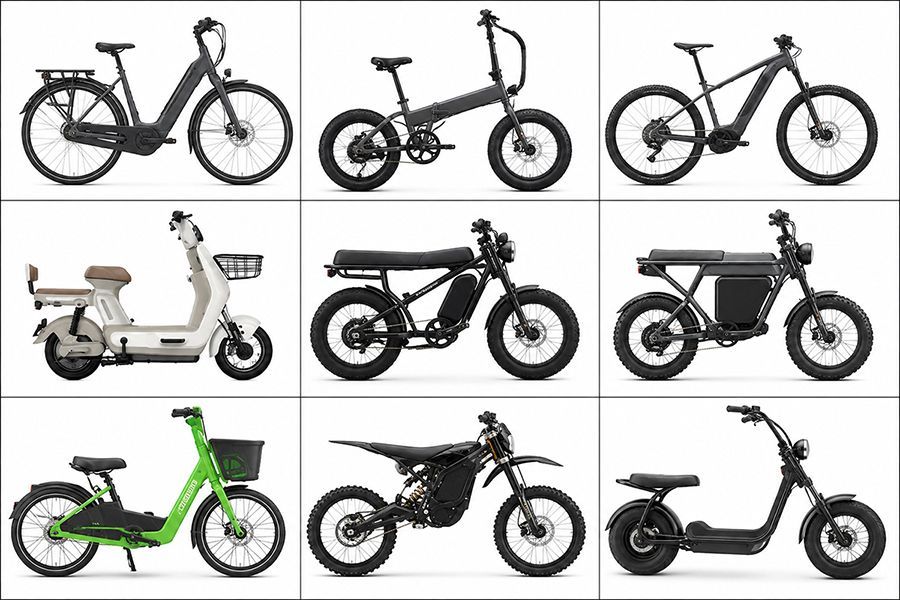
One of the report’s central findings is that California is struggling to regulate devices that are increasingly difficult to consistently define.
Researchers repeatedly emphasized that many of the devices commonly referred to as “e-bikes” by the public, retailers, media outlets, and even crash reports may not legally qualify as electric bicycles under California law.
What Is a Legal Electric Bike in California?
At the federal level, electric bicycles were first formally defined through HR 727 (2002), which established that a “low-speed electric bicycle” must have fully operable pedals, a motor under 750 watts, and a top motor-powered speed below 20 mph.
California later adopted the now-familiar three-class system:
- Class 1: Pedal-assist only, with motor assistance up to 20 mph
- Class 2: Throttle-assisted, with motor assistance up to 20 mph
- Class 3: Pedal-assist only, with motor assistance up to 28 mph
All three classes are limited to motors producing no more than 750 watts of power.
The challenge is that many devices currently marketed as “e-bikes” exceed those legal limits. Some manufacturers ship devices with software-limited settings that technically comply with Class 2 or Class 3 rules, while also advertising how easily users can unlock higher speeds and power outputs through apps or onboard displays.
The report highlights several examples, including the Lyric Graffiti, Aipas M2 Pro, and Bakcou devices, which can often be switched to much faster or more powerful modes in seconds.
Researchers also noted that class stickers can be easily purchased online, making it difficult to determine whether some devices are truly compliant. Senate Bill 1271 (2024) attempted to address part of this issue by prohibiting manufacturers from marketing devices as legal e-bikes if they are intentionally designed to be easily unlocked beyond California’s legal limits.
California has been responding to these deceptive tactics manufacturers use to increase sales with new legislation specifically aimed at regulating illegal e-motos.
The U.S. Is an Outlier in How It Regulates Electric Bicycles
The MTI report found that the United States regulates electric bicycles differently from many other countries. In California and most U.S. states, all three classes of legal e-bikes are generally treated as bicycles. That means riders do not need a driver’s license, vehicle registration, license plate, or insurance to operate them.
However, in 2026, New Jersey became the first state to require registration, licensing, and insurance for electric bicycles, eliminating the traditional three-class system entirely. The law treats all e-bikes more similarly to motorized vehicles, a dramatic shift from how most states currently regulate them.
In many other countries, electric bicycle rules are more restrictive. The report found that Europe, Japan, and several other countries often set lower maximum power limits and lower assisted-speed limits for devices that can be ridden like bicycles. Some countries also prohibit throttles on bicycle-equivalent electric devices.
Many countries use lower continuous-power limits. The European Union generally limits bicycle-equivalent e-bikes to 250 watts of continuous power with assistance capped at roughly 15.5 mph (25 kph). Japan also uses a 250-watt limit, while Canada generally limits electric bikes to 500 watts.
The report notes that the U.S. is a major outlier both in permitted wattage and in the classifications of electric bicycles. Many countries use a simpler two-category system in which lower-speed devices are treated like bicycles, more closely matching human power output. Higher-speed or higher-powered devices are regulated more like mopeds, requiring licensing, registration, helmets, and restrictions on where they may be ridden.
That comparison raises one of the report’s most important future-policy questions for California:
Should California continue using the current three-class e-bike system, or move toward a simpler system that separates lower-power bicycle-equivalent devices from higher-power devices that function more like mopeds?
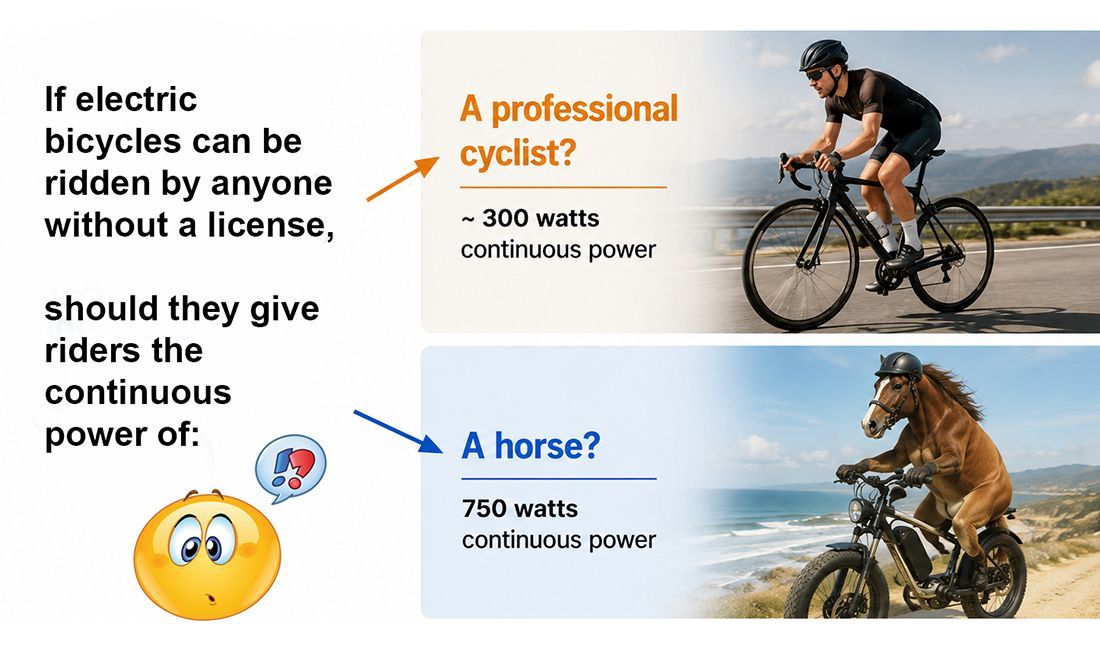
Currently, California law does not specify whether the 750-watt maximum refers to peak power or continuous power. That distinction matters because peak power measures the highest output a motor can briefly produce, while continuous power measures the amount of power a motor can sustain over time without overheating.
A recreational cyclist may produce roughly 100 watts of power, while a professional cyclist might sustain 200 to 300 watts, and only reach 750 watts briefly. A legal U.S. e-bike can currently produce up to 750 watts, roughly equal to one horsepower if measured as continuous power.
Researchers recommend revising California law so the 750-watt limit refers specifically to peak power, not continuous power. The report argues that this approach would better align e-bikes with the power output of strong human cyclists and more closely match international standards.
Researchers also warn that some higher-powered electric devices now on the market can produce the equivalent power of multiple horses, far beyond what lawmakers likely intended for devices regulated like conventional bicycles.
People Won’t Follow Rules They Can’t Understand or Remember
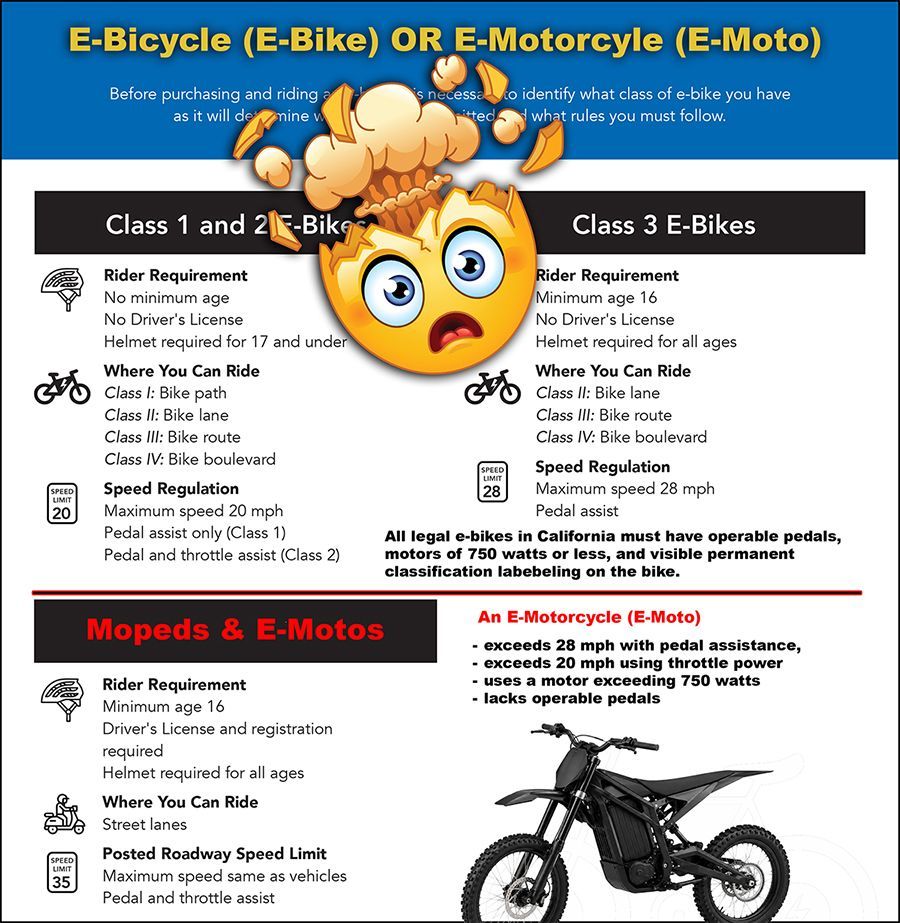
Most riders, parents, retailers, law enforcement officers, and even transportation professionals struggle to fully understand California’s current electric bike laws and classification system.
California does not currently provide a complete, plain-language guide explaining all e-bike laws and operating rules in one place. Instead, riders often rely on internet searches, retailer information, social media videos, or incomplete summaries that may be inaccurate or outdated.
Researchers noted that even basic rules can become confusing, including:
- where different classes of e-bikes may legally ride,
- whether sidewalk riding is allowed,
- helmet requirements,
- age minimums,
- trail access,
- and whether a device legally qualifies as an e-bike in the first place.
Many California municipalities have also begun adopting local pilot programs that establish additional temporary rules on minimum ages and helmet requirements.
Examples include San Diego’s ability to restrict children under 12, and Marin County's enforcement of e-bike helmet and age rules.
Bad Data Leads to Bad Electric Bicycle Policy
Another of the report’s most important findings is that current electric bicycle safety data has serious limitations. Researchers repeatedly warned that policymakers are attempting to regulate electric bicycles using incomplete, inconsistent, and potentially inaccurate information.
Most states still do not separately track electric bicycle crashes. Researchers identified only a small number of states that allow police officers to specifically classify e-bikes in crash reports. California did not begin formally coding e-bike crashes until 2017. Therefore, many early incidents were likely underreported because officers were still unfamiliar with the new classification system.
The report also found major inconsistencies in how hospitals, police departments, researchers, and the public identify electric bicycles. In many cases, crash reports and medical records simply classify a device as an electric bicycle without documenting its class, power output, top speed, or whether it legally qualifies as one at all.
Researchers concluded that class-specific crash data is “virtually nonexistent,” making it extremely difficult to compare the safety performance of different types of devices. The report also notes that many incidents are likely never reported, while accurate risk-per-mile or risk-per-trip calculations are nearly impossible to produce because reliable ridership and usage data are scarce.
Perhaps the report’s most striking conclusion is this:
Many, if not most, incidents likely did not involve legal e-bikes.
Many crashes attributed to electric bicycles may actually involve higher-powered electric devices that exceed California’s legal e-bike definitions. If true, that distinction could significantly affect how policymakers interpret crash trends and future regulation proposals.
Why Some Communities Are Seeing Very Different Trends
One reason the electric bike debate has become so polarized is that safety data can look dramatically different depending on the community being studied.
At the statewide level, conventional bicycle crashes still far exceed reported e-bike crashes. California recorded 10,372 conventional bicycle crashes in 2024 compared to 961 reported e-bike crashes.
But some local communities are experiencing very different patterns.
The Orange County Sheriff's Department crash data reviewed in the report identified more than twice as many reported e-bike crashes as conventional bicycle crashes. Researchers also pointed to local concerns in Marin County and New York City, where some datasets similarly showed unusually high rates of e-bike-related incidents compared to conventional bicycles.
The report suggests one possible explanation may be the growing presence of higher-powered electric devices that do not legally qualify as e-bikes under California law.
In 2025, studies conducted in Marin County and San Mateo County school districts found that only 12% of observed electric two-wheelers parked outside of schools appeared to be legal Class 1, 2, or 3 e-bikes.
Let’s put that into perspective:
Nearly 90% of the electric two-wheelers observed at schools appeared to be higher-power and higher-speed devices that are not legal electric bicycles.
These findings help explain why many communities, such as Orange County, are cracking down on illegal e-motos and holding parents accountable. Previously, the grand jury stepped in to identify dangerous regulatory gaps.
Some Electric Device Injuries May Be More Severe
The report found that electric bicycle-related injuries often appear more severe than injuries involving conventional bicycles, though researchers caution that the data remains inconsistent and difficult to interpret.
Several studies reviewed in the report suggest that electric bicycle incidents can lead to higher rates of hospitalization and fatalities. However, some large datasets showed only modest differences in injury severity between electric bicycles and conventional bicycles.
One possible explanation is that many electric devices are heavier and faster than conventional bicycles, resulting in greater crash forces and longer stopping distances.
Researchers also pointed to rider inexperience, aftermarket speed modifications, and the growing popularity of higher-powered devices capable of motorcycle-like performance.
California Needs Better Electric Bicycle Definitions, Data, and Education
While the report identifies major gaps in electric bicycle data and regulation, researchers also outlined numerous opportunities for California to improve safety while continuing to support electric bike use.
Importantly, the report does not recommend banning electric bicycles. Instead, researchers conclude that improving safety will require a broad combination of infrastructure, education, clearer laws, better enforcement, and significantly improved data collection.
1. Improve Infrastructure and Statewide Coordination
Researchers emphasized that safer infrastructure remains one of the most important ways to improve safety for all riders, including e-bike users.
The report encourages California to continue investing in high-quality bicycle infrastructure, including protected bike lanes, safer intersections, and street designs that reduce conflicts between motorists and vulnerable road users.
The report also recommends integrating e-bike policy into broader micromobility and transportation planning efforts. Suggestions include creating statewide staff positions focused on micromobility coordination and incorporating electric bicycles into existing state transportation and safety programs.
2. Clarify Electric Bicycle Definitions and Regulations
One of the report’s most significant recommendations is that California reconsider how it defines and regulates electric bicycles.
Researchers proposed simplifying the current three-class system into two categories:
- Lower-power electric bicycles regulated like conventional bicycles
- Higher-powered devices regulated more like mopeds
The report also recommends clarifying the legal status of the many “bicycle-shaped devices” that currently do not clearly fit into any category within the California Vehicle Code.
3. Expand Public Education and Safety Awareness
The report repeatedly notes that most Californians do not fully understand current electric bike laws or safe riding practices.
To address this, researchers recommend:
- Creating a plain-language handbook explaining California’s e-bike rules
- Adding electric bike safety information to DMV educational materials
- Developing age-specific safety education materials
- Offering electric bicycle safety training courses
- Producing public service campaigns focused on safe riding practices and roadway awareness
Researchers also emphasized the importance of educating all road users, not just e-bike riders. This includes helping motorists better understand how to safely interact with bicyclists and electric bicycle riders on public roads.
4. Improve Enforcement and Retailer Accountability
The report recommends stronger retailer disclosure requirements so consumers better understand what type of device they are purchasing and how it may legally be used.
Researchers suggest requiring retailers to disclose:
- whether a device legally qualifies as an electric bicycle,
- the device’s class designation,
- applicable riding rules,
- and whether the device exceeds California’s legal e-bike limits.
The report also recommends clearer enforcement processes for illegal or modified devices, including guidance for law enforcement agencies.
Researchers noted that some manufacturers currently market higher-powered devices as legal e-bikes while also promoting how easily speed and power settings can be unlocked through apps or onboard displays.
5. Improve Data Collection, Research, and Data Sharing
A major theme throughout the report is that
California cannot create effective long-term policy without significantly better data.
Researchers recommend improving the quality of crash and injury reporting, collecting more detailed information about the devices involved in incidents, and improving statewide coordination between hospitals, police departments, transportation agencies, and researchers.
The report also calls for:
- better tracking of e-bike ridership and use rates,
- creation of an electric bicycle data repository,
- easier public access to safety data,
- improved data sharing across agencies,
- and expanded research into electric bicycle safety trends.
Current data systems make it difficult to accurately determine what types of devices are involved in crashes, how often incidents occur, and which safety interventions are most effective.
What Happens Next for California E-Bike Policy?
The MTI report makes one thing clear: California’s e-bike problem is far more complicated than simply deciding whether e-bikes are safe or dangerous.
Researchers found that electric bicycles offer major transportation and mobility benefits, but they also identified significant problems with how crashes, injuries, and electric devices themselves are currently classified, regulated, and reported.
The report calls for safer infrastructure, clearer laws, better public education, stronger retailer disclosures, improved enforcement, and far better crash and injury data collection.
The findings may also influence policy beyond California. As other states begin to regulate electric bicycles, the broader national debate surrounding e-bikes and higher-powered electric devices is likely only beginning.
Bike Legal: California’s Leading Bicycle Accident Attorney
Bike Legal supports the safe and legal use of e-bikes as part of our broader advocacy to increase bicycling and improve safety for everyone. As electric bicycles continue evolving, so do the e-bike laws, regulations, and safety challenges surrounding them.
Our team closely tracks bicycle and e-bike legislation, safety research, and transportation policy developments affecting riders across California and the United States. We represent cyclists and e-bike riders injured in crashes involving negligent drivers, unsafe road conditions, and other dangerous roadway situations.
If you have questions about a crash or laws pertaining to bicycles and e-bikes, give us a call or send us a message. We are here to help 24/7 at no cost to you.
📞 Call 877-BIKE-LEGAL (877-245-3534) for a free consultation.
Frequently Asked Questions (FAQ)
What is California Senate Bill 381?
California Senate Bill 381 (2023) ordered a statewide study on e-bike safety, crashes, injuries, fatalities, and regulations. The study was conducted by the Mineta Transportation Institute (MTI) to help lawmakers develop future California e-bike laws and safety policies.
What did California’s 2025 e-bike safety study find?
The MTI report found that e-bike crashes and injuries are increasing, but researchers also identified major problems with current e-bike crash and injury data. The report states that many reported “e-bike” incidents may not involve legal e-bikes under California law.
What is considered a legal e-bike in California?
A legal e-bike in California must have fully operable pedals, a motor no greater than 750 watts, and fall into one of three legal e-bike classes:
- Class 1 e-bike: Pedal assist up to 20 mph
- Class 2 e-bike: Throttle assist up to 20 mph
- Class 3 e-bike: Pedal assist up to 28 mph
Why are California e-bike laws becoming more controversial?
California e-bike laws are becoming more controversial because many high-powered electric devices sold as “e-bikes” may exceed California’s legal speed and wattage limits. Researchers also found widespread confusion surrounding e-bike classifications, helmet laws, age restrictions, sidewalk riding, and where different devices may legally operate.
Are e-bike injuries more severe than bicycle injuries?
The MTI report found that e-bike injuries are often more severe than conventional bicycle injuries, though researchers say the data remains inconsistent. Heavier devices, faster speeds, and higher-powered motors may contribute to more serious crashes and injuries.
Why is California’s e-bike crash data unreliable?
Researchers found that most states do not separately track e-bike crashes, hospitals and police departments often classify devices differently, and e-bike class information is rarely recorded. The report concluded that “many (most?) incidents likely did not involve legal e-bikes.”
Are Sur-Rons and other e-motos legal e-bikes in California?
Many Sur-Rons, Talarias, and other high-powered e-motos do not legally qualify as electric bicycles in California because they exceed the state’s 750-watt motor limit or speed restrictions. Some may instead fall into moped, motorcycle, or off-highway vehicle categories.
Could California change its current e-bike classification system?
Possibly. The MTI report recommends that California consider replacing the current three-class e-bike system with a simpler two-category system that separates lower-powered e-bikes from higher-powered electric devices, which would be regulated more like mopeds.
How can California improve e-bike safety, laws, and policies?
The MTI report recommends improving e-bike safety through safer bicycle infrastructure, clearer e-bike laws, better rider education, stronger retailer disclosure requirements, improved enforcement, and more reliable crash and injury data collection. Researchers also recommend simplifying California’s e-bike classification system and creating statewide guidance explaining e-bike rules and safe riding practices.
How many e-bikes are in the United States?
The MTI report estimates there are now approximately 7 million bicycle-shaped electric devices in circulation across the United States in 2025. Researchers noted that the market has grown rapidly in recent years, with electric bicycle sales increasing dramatically since 2020
Bike Legal Spoke & Law Blog


Ride Protected
Ride Safe, with Bike Legal
At Bike Legal, our mission is to advocate for bicycle safety and to share the road responsibly through education. Our legal team is committed to supporting and representing cyclists across the United States, no matter where you ride or how you ride.